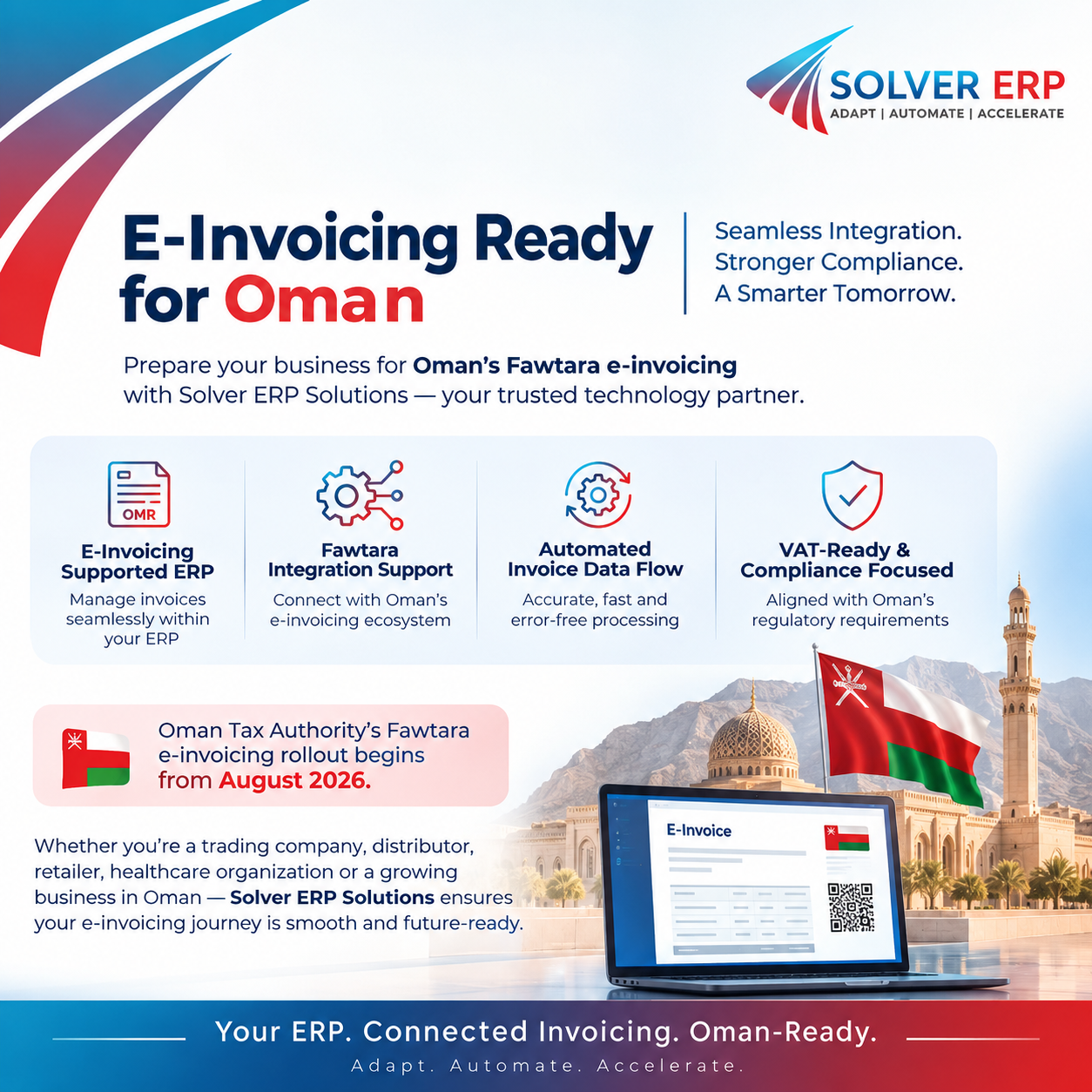
For businesses in Oman, this means choosing the right technology is becoming increasingly important.
An ERP system that manages finance, sales, purchasing, inventory and invoicing can play a central role in preparing for e-invoicing. Instead of treating e-invoicing as a separate process, businesses can integrate invoicing into their existing ERP workflows and create a more connected digital operation.
Fawtara is Oman’s electronic invoicing framework, designed to support the digital exchange and processing of invoice information between businesses and the relevant tax ecosystem.
The implementation is being introduced in phases, making it important for businesses to start assessing their current invoicing and ERP capabilities early.
For many organizations, the key question is no longer simply:
“Can our accounting system create an invoice?”
The more important question is:
“Can our ERP support the data, processes and integrations required for Oman’s e-invoicing environment?”
This distinction matters because modern e-invoicing involves more than generating an invoice document.
Traditional invoicing processes can involve multiple disconnected systems. A sales team may create an order, an accounting team may generate an invoice, inventory information may be maintained elsewhere, and tax-related data may require additional processing.
This can result in:
An ERP with e-invoicing capabilities can help bring these processes together.
When sales, inventory, customer, accounting and invoicing information are connected within one system, businesses can create a more reliable flow of invoice data from the original transaction through to the final invoicing process.
A properly configured ERP can become the central source of transaction and invoice data.
For example, when a sales transaction is completed, the relevant information can flow through the ERP's sales and finance modules rather than being manually re-entered into another invoicing application.
This can help businesses improve:
Invoice information can be generated from existing ERP transactions, reducing the need for repetitive manual entry.
This can help minimize duplication and improve data consistency across sales and finance operations.
E-invoicing requires businesses to manage invoice information in a structured and digitally accessible manner.
An ERP can help maintain customer, product, tax, pricing and transaction information within connected business processes.
Businesses can maintain relevant VAT and invoice information within their ERP workflows, helping finance teams manage invoicing more consistently.
Businesses may need to connect their ERP and invoicing processes with the appropriate service provider and e-invoicing infrastructure.
An ERP that supports integration capabilities can make this transition more manageable.
When invoicing is connected to sales, inventory and accounting, management can obtain a clearer view of receivables, sales transactions and financial activity.
Before selecting or upgrading an ERP, businesses should evaluate whether their existing system can support the requirements of their future invoicing environment.
Here are some important areas to consider.
Your ERP should be able to connect invoicing with the rest of your business operations.
Sales, inventory, purchasing and finance should not operate as isolated systems.
The ERP should have suitable integration capabilities to connect with external e-invoicing infrastructure or service providers as required.
Customer information, product details, pricing, tax information and invoice data should be maintained consistently.
The more invoice-related processes that can be automated, the less dependence the business has on manual intervention.
Your ERP should be able to support your business as transaction volumes, customers, branches and operational requirements increase.
Finance teams should be able to access invoice information and related transaction records efficiently for reporting, reconciliation and business analysis.
Businesses can start with a simple ERP readiness assessment.
Ask the following questions:
Can our ERP generate invoices from sales transactions?
Is our customer, product and tax data maintained in a structured format?
Can our ERP integrate with external platforms or service providers?
Can invoice information move automatically between sales and finance?
Are we relying heavily on spreadsheets or manual invoice entry?
Can our ERP support multiple branches, business units or growing transaction volumes?
If the answer to several of these questions is “no”, it may be time to review your ERP strategy before the e-invoicing transition progresses further.
Waiting until e-invoicing becomes mandatory for your organization can create unnecessary pressure.
ERP changes, integrations, data cleansing, process changes and employee training can take time. Businesses may also discover that their existing systems require customization or additional integration work.
Starting early gives organizations an opportunity to:
The goal should not simply be to become technically compliant. Businesses should use the transition as an opportunity to improve their overall digital finance operations.
Solver ERP Solutions provides ERP solutions and integration capabilities designed to help businesses manage their finance, sales, inventory and invoicing operations through connected workflows.
With an e-invoicing-ready ERP approach, businesses can work toward:
Whether you operate a trading company, distribution business, retail organization, pharmacy, healthcare business or growing SME in Oman, your ERP can be an important part of your e-invoicing readiness strategy.
The transition to e-invoicing is more than an invoicing-system upgrade. It is an opportunity to connect your business processes, reduce manual work and build a more digitally integrated finance operation.
If your business operates in Oman, now is the right time to assess whether your ERP is ready for the next stage of digital invoicing.
One ERP. Connected Invoicing. Oman-Ready.
Contact Solver ERP Solutions to discuss your ERP and e-invoicing requirements.
Phone: +968 97000404
Email: sales@solver-erp.com
Website: www.solver-erp.com
Solver ERP celebrates the successful Go-Live of Smart HIS and Smart EMR at Badr Al Samaa Group of Hospitals, Ruwi, marking another milestone in our shared healthcare technology journey.
Maxcare Hospital becomes the first hospital in Oman to launch Dhamani e-Rx Phase 2 with Solver ERP, advancing digital healthcare and paperless insurance.
We have successfully generated the first e-prescription (e-Rx) from Al Maha Polyclinic and downloaded it seamlessly at Scientific Pharmacy LLC, Ghubra. To complete the cycle, the prior authorization (pre-auth) request was sent for the same e-Rx and the insurance response has been received successfully.
Oman is rewriting the rules for how businesses issue, send, and store invoices — and the change is bigger than a routine tax update. With Fawtara, the new national e-invoicing initiative from the Tax Authority of Oman, the country is laying digital infrastructure that supports its wider goal under Oman Vision 2040: a modern, tightly integrated economy where transactions move as fast as data does.
Healthcare communication is changing faster than ever before. What once relied heavily on phone calls and face-to-face interactions is now evolving into a more connected, digital, and patient-centric experience.